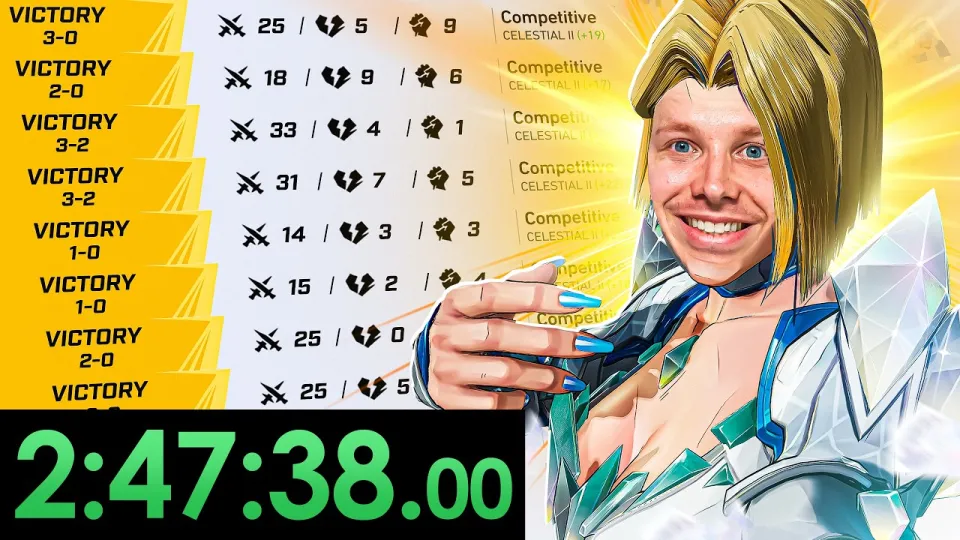
Marvel Rivals becomes a survival challenge when Jay3 turns every loss into the end of the video
Want articles like this for your own video to promote it on YouTube and Google? Order them through the Telegram bot @sat_sit_bot. It writes articles around your video, embeds the video and publishes them on popular niche websites (no ads). Your first 50 articles are free.
· based on the channel Jay3
Marvel Rivals is the game, and the rule is simple: if Jay3 loses a match, the video ends right there. The format turns an ordinary ranked session into a survival run where every fight carries the weight of the whole upload, and it is the same pressure-cooker setup that made his Overwatch spectating content popular. You can catch the live version of these sessions on his Twitch channel, where the Marvel Rivals grind happens.
How the lose-and-the-video-ends rule changes a Marvel Rivals session
The rule converts a normal play session into a single continuous run with no reset button. In a standard ranked grind, a loss is a data point; here it is a hard stop, so the stakes of every match escalate the longer the run survives.
Three things shift when a content creator plays under this condition:
- Hero choice becomes conservative. Off-meta picks and experimental team compositions cost too much when a single defeat ends the recording.
- Tilt control matters more than aim. One bad fight cannot be allowed to snowball into a lost match, because there is no next game to recover in.
- Team coordination gets prioritized. In Marvel Rivals, where team-up abilities reward specific hero pairings, picking around the team is safer than picking around personal preference.
The format is a staple of Jay3's channel across both Overwatch and Marvel Rivals, and it works because it mirrors how most players actually feel about ranked: the next loss always seems like the one that ends the night.
Marvel Rivals basics the run depends on
Marvel Rivals is a free-to-play 6v6 hero shooter from NetEase Games, built around Marvel characters split into Vanguard, Duelist and Strategist roles. Matches are objective-based, and teams fight over capture points and payload-style pushes across destructible maps.
The mechanic that separates it from other hero shooters is the team-up system: certain hero combinations unlock bonus abilities, so a roster is never just six individual picks. A run built on not losing has to respect that, because a team-up-enabled composition usually beats six strong solo picks with no synergy. Seasonal content adds new heroes and balance changes regularly, which means a strategy that survives one run can be obsolete the next.
Role discipline is the other pillar. A team with no Vanguard melts under pressure, and a team with no Strategist has no sustain. In a survival format, Jay3 cannot afford to fill a role badly and hope the next lobby is kinder.
Why Spider-Man players and throwers decide these runs
The most common way a no-loss run dies is not a fair loss but a targeted one. Viewers of the video flagged a Spider-Man player who spent the match hunting Jay3 specifically, and that pattern is familiar to anyone who has been visibly streamed in a hero shooter.
Spider-Man is Marvel Rivals' most mobile dive Duelist. He swings across the map, drops onto isolated targets and leaves before the team can collapse on him. Against a streamer whose position is public on stream, that kit becomes a griefing tool: the Spider-Man does not need to win the match, only to make one player's life miserable. Counterplay exists but is expensive:
- Swap to a hero with reliable anti-dive tools and stay near a Strategist.
- Group up so the dive lands into two or three players instead of one.
- Give up the isolated angle entirely, even if it means lower damage output.
Throwers are the second run-killer. Players report Marvel Rivals ranked games where a teammate deliberately sabotages the match, from teleporting the team off the map to feeding on purpose. In a format where one loss ends the video, a single bad actor in the lobby is enough to cut the run short, and no amount of individual skill fixes a teammate who is actively working against the team.
Overwatch habits that carry over to Marvel Rivals
Jay3's background is Overwatch at grandmaster level, and that history shapes how he approaches Marvel Rivals. The two games share enough DNA that the transfer is real, but not automatic.
What carries over:
- Ult economy: tracking which enemy ultimates are ready and baiting them out before committing.
- Positioning: playing cover, holding high ground and knowing when a fight is already lost.
- Role flexibility: filling whatever the composition needs rather than locking one hero.
What does not carry over cleanly is the team-up system and the specific hero kits. Marvel Rivals rewards players who learn which duo abilities are worth building around, and a grandmaster Overwatch resume does not shortcut that knowledge. Viewers who came from Overwatch have noticed the adjustment period, and some still ask for Overwatch content alongside the Rivals uploads.
What viewers ask about the format and the ranked experience
The comment section under the video reads like a snapshot of the Marvel Rivals ranked experience in 2026. Placement matches are a recurring sore point, with players describing runs where most games were lost to teammates who gave up or sabotaged the match rather than to better opponents.
Another recurring theme is the mismatch between how players rate themselves and the rank they actually hold. The suggestion of pitting a team of hardstuck players against a team of the rank they believe they deserve is a running joke in the community, and it speaks to a real frustration: ranked anxiety and blame-shifting are as much a part of Marvel Rivals as the hero picks.
For anyone trying the no-loss format themselves, the practical advice is unglamorous:
- Play in a duo or trio so at least one teammate is reliable.
- Warm up in quick match before starting the run.
- Stop after two losses in a row even if the video rule allows only one.
- Review the loss before queueing again, focusing on positioning rather than teammates.
The format is entertainment first, but the discipline it forces is genuinely useful for climbing.
All the links from the video
- Live streams: https://twitch.tv/jay3
- Twitter: https://twitter.com/jay3ow
- TikTok: https://tiktok.com/@jay3twitch
- Instagram: https://instagram.com/jay3twitch
- Discord: https://discord.gg/jay3
Final thoughts on Jay3's Marvel Rivals survival run
The lose-and-the-video-ends format works because it strips Marvel Rivals down to what makes ranked tense: one bad lobby can undo an entire session. Jay3's Overwatch grandmaster habits give him a foundation, but Spider-Man dives, throwers and team-up-dependent compositions keep the outcome genuinely uncertain. The video breakdown comes from the Jay3 channel, and the live version is where the run actually happens, so follow along at twitch.tv/jay3 if you want to see whether the next run survives the first match.
Key takeaways
- Jay3's Marvel Rivals video follows a single rule: if he loses a match, the video ends immediately.
- The format aired on October 2, 2026 and was edited by Snoozy, with the thumbnail by hiimishie.
- Jay3 is a former Overwatch grandmaster player who now splits time between Overwatch and Marvel Rivals.
- Viewer discussion around the video centers on Spider-Man players hard-targeting streamers and on throwers in ranked.
- Jay3 streams live on Twitch at twitch.tv/jay3, where the Marvel Rivals sessions originate.
Questions & answers
What happens if Jay3 loses a match in the Marvel Rivals video?
The video ends immediately. The whole upload is built as one continuous run, so a single loss stops the recording and the session is over. That is why hero picks and team coordination skew conservative compared to a normal ranked grind.
Why do Spider-Man players target streamers in Marvel Rivals?
Spider-Man is the most mobile dive Duelist in the game, so he can reach an isolated target and escape before the team reacts. When a player's position is visible on stream, that mobility turns into easy griefing. The counter is to group up, stay near a Strategist and give up isolated angles.
Is Marvel Rivals ranked full of throwers?
It happens often enough that players bring it up constantly, including deliberate sabotage like teleporting teammates off the map. In a no-loss format, one bad actor in the lobby can end the run regardless of individual skill. Playing in a duo or trio is the simplest mitigation.
Does Overwatch experience help in Marvel Rivals?
Partly. Ult tracking, positioning and role flexibility transfer directly, which is why a grandmaster Overwatch background gives a real head start. The team-up system and specific hero kits do not transfer, so time still has to go into learning which duo abilities are worth building around.
Source: IF I LOSE, THE VIDEO ENDS... (Marvel Rivals) · Markdown version